
Site inspection
Review the vehicle parking position, charger mounting location, switchboard, cable route and property access.
Install a safe, dedicated EV charger designed around your vehicle, parking layout, switchboard capacity and solar energy goals. PDG Energy provides licensed installation, site assessment and clear fixed-scope quoting.
EV charger service
A dedicated home EV charger can be more convenient than relying on a standard power point, especially when charging becomes part of your daily routine.
PDG Energy plans EV charger installations around your switchboard capacity, charger location, cable route, solar generation and possible battery storage upgrades.
Clear installed pricing
A fixed-scope quote starts with the charger, vehicle and property, not a generic installed price.
Installed cost depends on the charger brand and model, charging capability, available supply, cable route and the electrical work required at your property.
What we cover
Your quote identifies the agreed charger, electrical scope and any site-specific exclusions before installation is booked.
Review the vehicle parking position, charger mounting location, switchboard, cable route and property access.
Assess the dedicated circuit, protection devices and available electrical capacity needed for the selected charger.
Plan safe charger mounting, cable routing, isolation equipment and weather exposure for the agreed location.
Complete electrical testing and explain safe day-to-day charger use after the installation is finished.
Set up app, scheduling or solar-aware charging features where the selected charger and energy system support them.
Charger brands
The models below have current Australian technical documentation. PDG Energy confirms current supply, vehicle connector compatibility and the final installation scope before quoting.
Type 2 models: X1-HAC-4 (4.6 kW), X1-HAC-7 (7.2 kW), X3-HAC-11 and X3-HAC-22. Wi-Fi, SolaX Cloud scheduling, solar compatibility and indoor/outdoor variants are documented.
SolaX G2 data sheet7 kW, 11 kW and 22 kW models with vehicle compatibility, SEMS+ monitoring and scheduling, solar and battery integration, dynamic load control and an IP66 enclosure for suitable indoor or outdoor locations.
GoodWe HCA G2 data sheetFox ESS Australia documents A Series options at 7.3 kW, 11 kW and 22 kW, plus L Series at 7.3 kW and 11 kW, with dynamic load balancing, schedules and PV linkage.
Fox ESS A Series data sheetAustralian 7.4 kW and 22 kW options with app control, solar charging and load balancing where paired with the required compatible metering and energy equipment. Its IP65/IK10 enclosure can suit assessed indoor or outdoor locations.
Anker SOLIX V1 product pageCharging speed explained
The charging rate your vehicle actually receives is limited by the charger, your home's supply and the vehicle's onboard AC charger.
| Charger capability | Common home supply | What determines actual speed | Typical planning use |
|---|---|---|---|
| 7 kW | Often single-phase | The EV must be able to accept the available AC rate; site load and charger settings also matter. | Common for regular overnight home charging. |
| 11 kW | Usually three-phase | Requires compatible three-phase supply and an EV with an 11 kW onboard AC charger. | Useful where shorter charging windows or higher daily driving demand are expected. |
| 22 kW | Three-phase | The property, protection, charger and vehicle must all support 22 kW; many EVs accept less. | Considered for high-demand homes or vehicles that can use the available rate. |
At the actual rate received, a vehicle adds about 7, 11 or 22 kWh of energy per hour before charging losses. The lower of the charger limit, property supply and vehicle onboard AC limit sets that rate. We confirm it before quoting.
Solar-aware charging
Smart charging can prioritise suitable excess solar generation, but it needs a compatible charger, solar system and charging settings.
Solar-aware charging, dynamic load control and scheduled charging are model-specific features that must be confirmed for the selected charger.
Daytime parking, solar generation, household loads and the vehicle's required charge level all influence whether excess-solar charging suits your routine.
Future storage can change how energy is allocated between the home and vehicle, so we include battery goals in the charger assessment.
We check your existing solar equipment and monitoring before confirming a solar-charging pathway. Explore solar installation or battery installation.
Confirm EV model, preferred charging location, parking layout and daily charging routine.
Assess switchboard, cable route, electrical capacity, solar system and future battery goals.
Install the charger, complete testing and explain basic use, safety and charging considerations.
Licensed & supported
A home charger should be installed by a licensed electrical team and matched to the property conditions.
South Australian electrical contractor licence PGE354203.
Recommendations are based on charger location, switchboard capacity and property access.
EV charging can be planned alongside solar generation and future battery storage.
PDG Energy provides setup guidance and customer handover after installation.
EV charger FAQ
These answers explain the practical details we check before confirming charger compatibility and installation scope.
Charging time depends on the vehicle battery level and capacity, your vehicle's onboard AC charger, the charger setting and the available supply. We confirm the supported rate from your EV model and property assessment.
A 7 kW charger can suit many homes and regular overnight charging routines, especially on single-phase supply. Whether it is enough depends on your driving, vehicle AC charging limit and available charging time.
Yes, many home chargers are designed for single-phase installation. The final charger setting, dedicated circuit and load assessment must match the available supply and your vehicle.
Compatibility depends on the current Wall Connector variant, vehicle inlet and the manufacturer's current documentation. Tell us your vehicle model so we can confirm the appropriate configuration before quoting.
With a compatible charger and solar setup, charging can be configured to prioritise suitable excess solar energy. Generation, household loads, charger features and charging settings determine the result.
Your quote sets out the selected charger, dedicated circuit and protection, mounting, cable route, isolation equipment, testing, handover and any site-specific electrical work or exclusions.
Not always. We inspect the switchboard, available capacity, protection requirements and proposed charger load before confirming whether any upgrade work is required.
Many chargers have outdoor-rated enclosures, but the selected model, mounting surface, weather exposure, cable management and electrical installation requirements must be checked for the proposed location.
Recent installation
Examples of the equipment and installation approach used on South Australian energy projects.
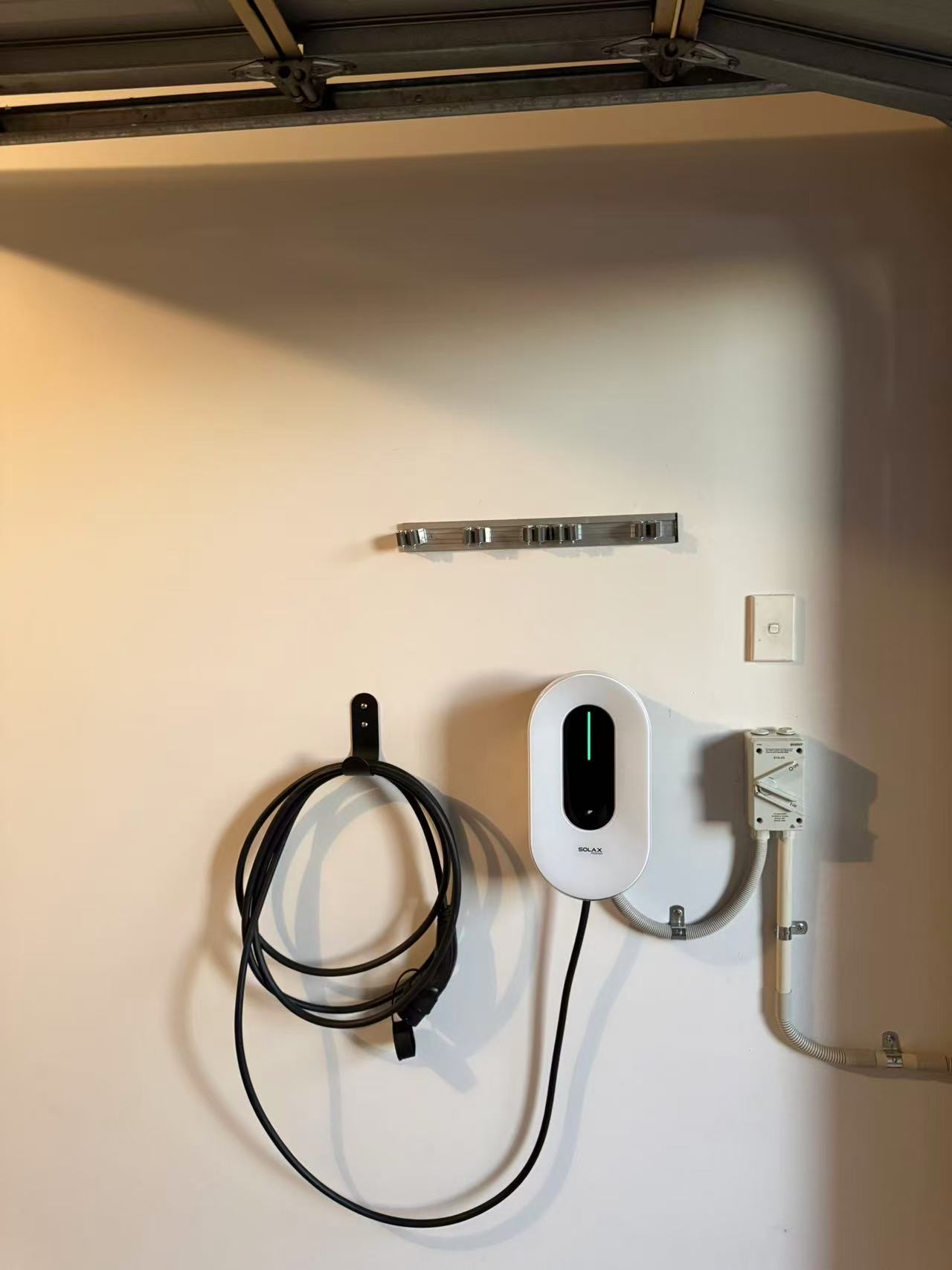
A recent SolaX home EV charger installation completed by PDG Energy, with a wall-mounted charger, dedicated isolation equipment and tidy cable management.
The charger location was planned for practical garage access, safe electrical connection and convenient daily charging. Switchboard capacity, cable routing and future solar or battery plans are reviewed before installation.
We will assess your vehicle, parking layout, switchboard, charging speed, solar system and installation scope before recommending a compatible charger.